
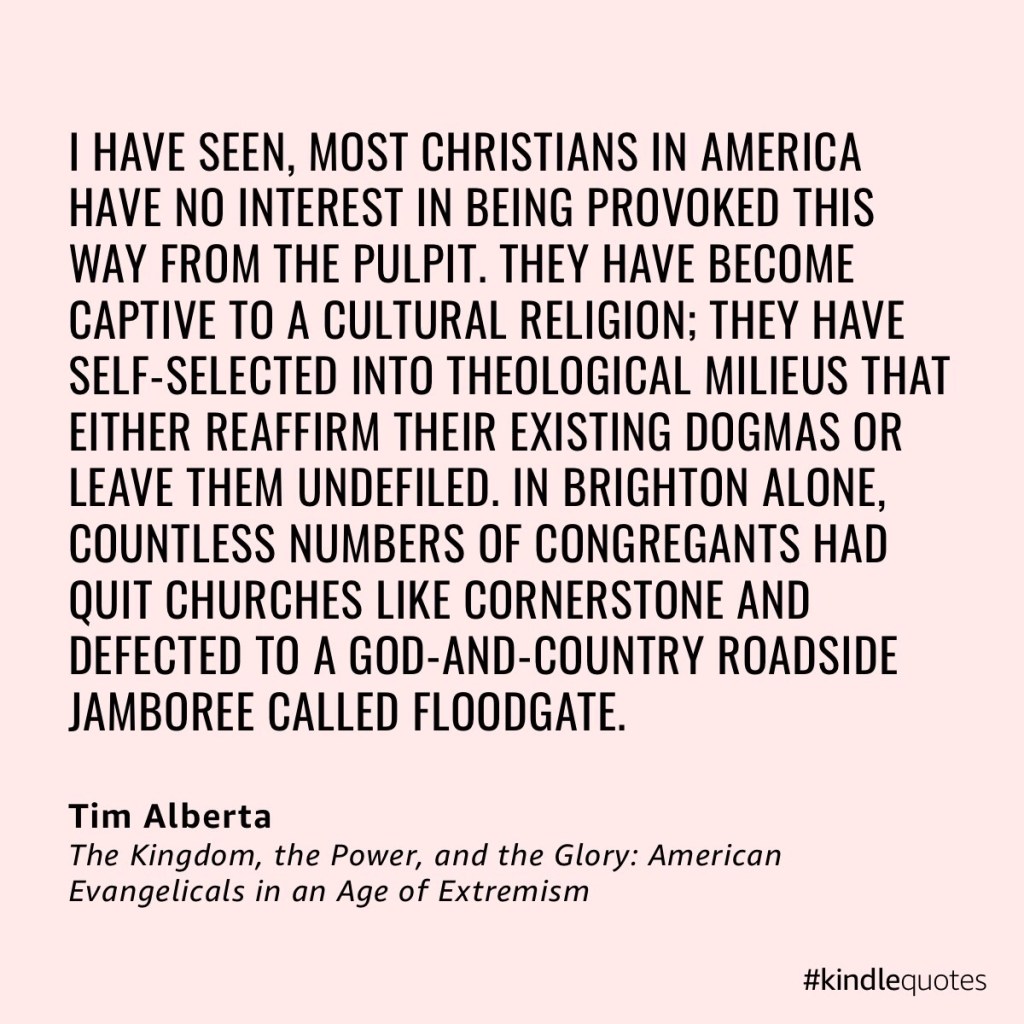
What preceded this conclusion? Let’s examine it.
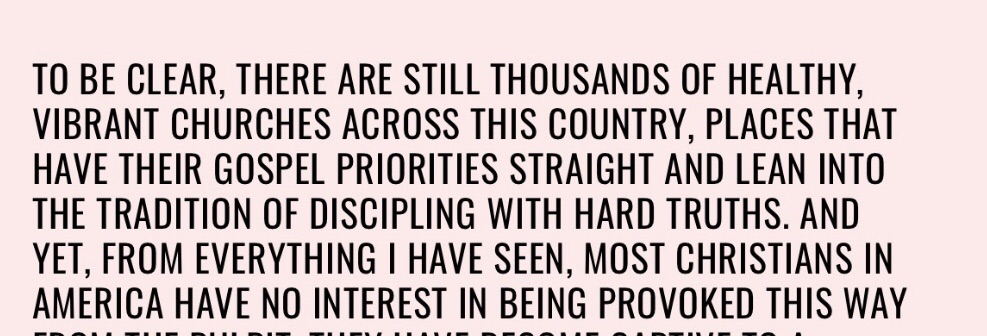
So where does Tim’s conclusion lead us? What are the hard truths? He has clearly implied throughout his book that the Scriptural truth given us by the early church did not cause us to operate the way that we are going as evangelicals; where we join ourselves to politics. Is he right? Is he right that every time that the Conservative Christian attaches his interest for providing a healthy and a wholesome society for their families and their friends, that they then have gone the way of the God and country roadside Jamboree? It seems that his conclusion is that the conservative Biblical message is rejected by the world as a political agenda; because to engage politics is too worldly.
So is it true that every liberal church which Tim makes no mention of at all herein, but which prides itself in the fact that they love god and country so much more than these conservatives, because they love the trees and the clean air and the animals so much. They also love the earth so much that they need to kill the cows and create their own artificial meat supply so that there will be no flatulence to pollute the air. Neither can they pollute the environment by drilling, so they must have electric cars, which require the mining of rare earth minerals. The mines of which are mostly owned (sold out by liberal politicians to China and Russia) and of course this is all sold as being green. Yet the electricity for their living and their cars comes to them through gas, oil and coal manufactured wind and solar parts all manufactured in China where they are building a new coal power plant every week. And they are shipping these parts by freighter requiring oil. Is this not a form of hypocrisy and does it not require an opposition?
If nothing else liberalism certainly is an enemy of conservative values in this our time. And they are every bit as political. Are all Christians both liberal and conservative to avoid politics when voting is an act of one’s beliefs on their world view?
Christians are to love, so then there is the love element. Does a Christian who loves others so much not vote, because to support someone in the vote may offend someone.
Are the issues unimportant? — open borders being against controlled borders: do uncontrolled borders mean that drugs and fentanyl are also uncontrolled; that children are trafficked; that criminals from other countries are entering; terrorists are entering; that Women are raped on the journey.
But the difference between rhetoric and actuality is still not just the hypocrisy of people that’s a given for every man, but is the willingness to follow God in the science that He created wrong?
Then there is the Gender issue, the fact that life is precious, children are his gift and the method of procreation. Children are your future, train them up in the Lord and when they are old they shall not depart. When God and country gives way to the acceptance of every god and every debauchery known to man to boot; then is that not worth standing up against? Which is it that pleases God? And when everything that God gave to us through Christ to give us victory over sin is ignored and by some is said to be untrue, does that result in a society becoming more evil and more imperfect including man himself?
Having said all that, I actually find myself agreeing with Tim when he blames the Church members themselves for the churches demise, but I disagree with his reasoning. And perhaps I’m equally as wrong in some of my thinking. It’s easy to handpick verses out of context to make our point, but what really happened to the early church does not resemble what you, Tim or even I do think. What had made her flourish is forgotten. why? The truth is they were rejected just as Christ was rejected. Yes there were souls saved, but they paid a price for accepting this God/man Jesus the Christ and His ways. Jesus had made clear when He said: “many are called but few are chosen”. What does that mean to you and me.
◦ It’s true that Paul said that he became all things to all men that he might win some. Did he really mean all as we think? He didn’t take on their sin. Does it mean that there was no meaning to righteousness or it’s being sought after? Is Tim being focused on just the conservatives propensity to sin really the total answer? He overlooks the liberal Church and her politic when he examines conservatives who fall into sin. To him it’s all the conservative Christian’s fault. This he definitely teaches and I’ll use his chapter on Liberty U, where I graduated? I have written about my concerns with Liberty in other posts. My concern was and is not their politic, but their inability to examine Scriptures that opposed just some of their thinking. But Is Tim’s main concern righteousness, when focusing on Trump and leaders who support him and putting them all in the sin basket because of the known sins of others of them in the camp (such as Liberty U leadership? I think not. And why is Tim looking at Trump at all, if all that we are to be seeing is the unseen kingdom? If we are to divorce ourselves from opposing all sin and the desired acts brought us by politicians and religious leaders, because some are sinful; then we must give up what God tells us to desire and stand for, and what we truly want for people when they finally do awaken to Christ.
◦ Tim is concerned actually with both the Church and people falling away from it. And he was concerned with our country and the fact that its no longer being interested in the Church, which is a big part of the eternal, but the part of the Church that is not eternal is not yet really a part of the Church is it? So in this life obviously we are concerned with that which is not eternal also. So though TIm ends with this admonition to focus on the eternal, still we cannot totally, and neither has he.
◦ Truth is we have two churches: The liberal and the conservative. And the truth again is that sin within either or both of those camps has turned people off. Sin is ugly, and I think that that is why God reveals in the Bible that He is against it. And what we all see is not a new thing:
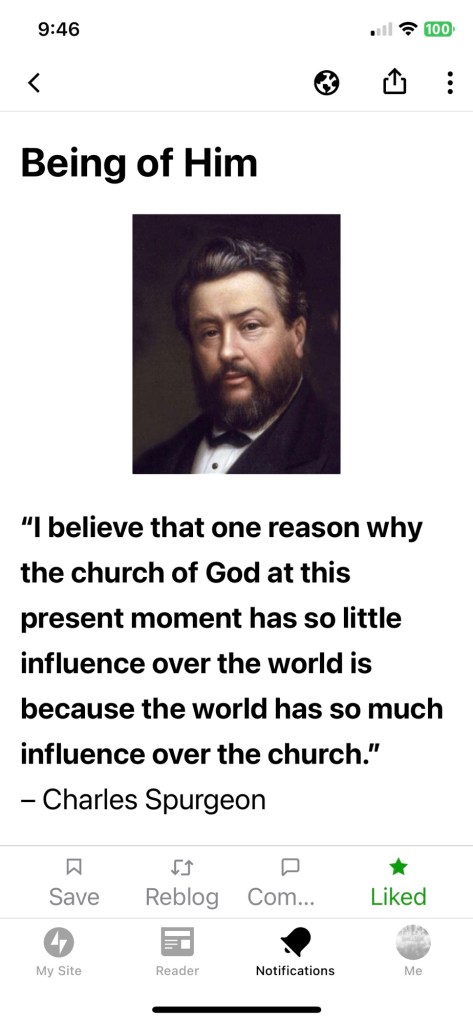
◦ So, I’m done with writing about Tim’s book. Next I’m looking at the sin that we are told by John not to pray for.
 And Then Messiah Shall Come
When the church loses her light it is no marvel that the nation goes dark. “Ye are the light of the world… Ye are the salt of the earth and if we lose our saltiness it is cast to the ground and is good for nothing.
God must allow the darkness to come so that the church in her desperation will once again turn to Him amidst the terrible persecutions, deprivations and the accompanying sorrows. When she loses her way in the worldliness and compromise she loses her privileges in God.
God removes the Lampstand of His ministrations to His church because she has left her first (primary) love… Such is His Wisdom and judgment.
Blessings
BT
LikeLiked by 1 person
We certainly are entering that dark place not just as a church but as a nation and a world. We are in the midst of testing.
LikeLike